AI Slop! The Unintended Consequences of the Backlash to Generative AI
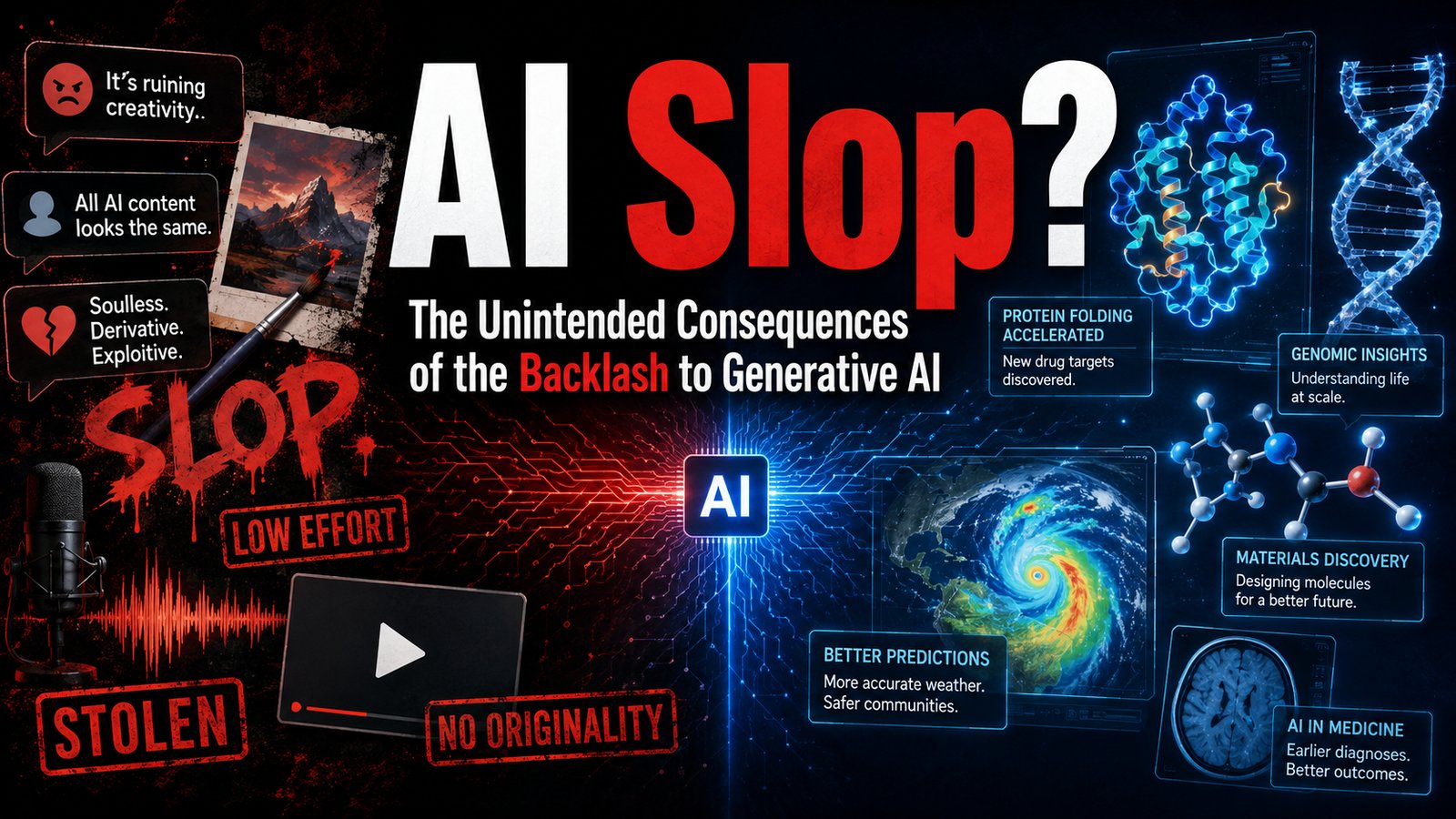
“I’m not against AI. I’m against generative AI.”
It’s the most common sentence in this entire argument. You’ll find some version of it under every AI-generated image, song, and video posted anywhere on the internet, usually within arm’s reach of the word slop.
It’s also a technical claim. Which means it can be checked.
The system that designs proteins which have never existed in nature is a diffusion model — the same method that produces a Midjourney image. The first gene editor designed by AI to successfully edit human DNA was generated by a language model, the same family of system as ChatGPT. The antibiotic that cleared a drug-resistant MRSA infection in a living animal came out of a variational autoencoder, one of the workhorse architectures of image generation.
This isn’t a clever comparison. Here is the opening line of the abstract of the Nature paper that introduced RFdiffusion, the protein design system:
“Diffusion models have had considerable success in image and language generative modelling but limited success when applied to protein modelling.”
That is the paper describing protein design as a continuation of image generation, because that is what it is. Researchers took the mathematics that makes pictures and aimed it at protein backbones instead of pixels.
So the distinction people are reaching for is real — consent, compensation, deception, all of it real — but the word they have attached it to is the name of a branch of mathematics.
Generative AI is a technical category. We are treating it as a moral one. And when a technical category acquires a moral charge, the consequences do not stay inside the part of it anyone was angry at.
That’s the argument. What it has already cost is the rest of this.
Nothing load-bearing below comes from an AI company. It comes from the World Health Organization, Nature, The Lancet, JAMA, PNAS, Pew, the International Energy Agency, and a run of papers co-authored by John Ioannidis — the researcher best known for arguing that most published findings are false.
What generative AI actually is
A generative model learns the statistical structure of some class of data and then produces new examples of it. That’s the whole definition. The class can be pixels. It can be words. It can also be protein backbones, molecular structures, DNA sequences, synthetic patient records, or the range of states the atmosphere might occupy five days from now.
“Generative AI” names a function — producing new structured output from learned patterns. It does not name a product category, and it does not name a purpose.
Three families of method do most of the work, and each of them spans the divide.
Diffusion models learn to reverse a process of adding noise. You start with static and step by step pull structure out of it. That’s Midjourney and Stable Diffusion. It’s also RFdiffusion designing novel proteins, and GenCast producing weather forecasts.
Transformers predict what comes next in a sequence. That’s ChatGPT. It’s also Evo 2, which models DNA across the entire tree of life, and OpenCRISPR-1, the gene editor.
Variational autoencoders compress data into a latent space and sample new points from it. That’s a family of image generators. It’s also what MIT’s Collins lab used to design antibiotics against drug-resistant infection.
These systems train on domain data. AlphaFold on the Protein Data Bank, Evo 2 on genomes, GenCast on decades of weather reanalysis. What they share with image generators is method, not training data.
Which means the connection isn’t “they used the same files.” It’s five other things, and they’re the ones that matter for policy. They share methods, so a rule written about “diffusion models” or “foundation models” doesn’t stop at the entertainment border. They share infrastructure — the same chips, the same data centers. They share researchers, who move between labs and problems. They share legal precedent: the most consequential ruling in British AI law to date, that a trained model is not a copy of anything, came out of a stock photography dispute, and every future UK question about training a medical model now rests on it. And they share social license, which is set by public mood rather than by application.
If you ban the method, you don’t get to keep the protein.
What it has already done
Breast cancer screening. In January 2026 The Lancet published the full results of MASAI, a randomized controlled trial run inside Sweden’s national screening programme. A hundred and five thousand women, randomly assigned to AI-supported mammography reading or the standard double-reading by two radiologists.
Sensitivity rose from 73.8% to 80.5% — a statistically significant improvement (p=0.031). Specificity did not move at all: 98.5% in both arms. The additional cancers were not bought with additional false alarms. Radiologists’ screen-reading workload fell 44%.
Interval cancers — the ones that surface between screenings because the last one missed them — came in at 1.55 per thousand with AI against 1.76 without. That difference is not statistically significant, and the trial was designed to test non-inferiority rather than superiority. What it establishes is that AI support caught meaningfully more cancer at screening without missing more between screenings and without recalling more healthy women.
A randomized controlled trial, in a real national health system, with more than a hundred thousand participants.
Antibiotics. In August 2025, James Collins’ lab at MIT published in Cell. They used a fragment-based variational autoencoder — the same family as image synthesis — to generate around seven million candidate compounds against drug-resistant gonorrhoea, narrowed them to eighty for synthesis, and got NG1, which cleared the infection in mice. A second unconstrained run generated more than twenty-nine million compounds, of which twenty-two were synthesized and tested, producing DN1, which cleared an MRSA skin infection in mice.
The antibiotic pipeline has been commercially dead for decades. Drug-resistant infection is one of the largest slow-moving health threats we have. This is a generative model producing molecules that killed real bacteria in real animals.
Gene editing. In July 2025 Nature published OpenCRISPR-1, from a company called Profluent. A language model trained on CRISPR-Cas sequences generated entirely new gene editors. OpenCRISPR-1 sits 182 mutations from the nearest protein found in nature and 403 from SpCas9, the workhorse editor it was designed to replace — and on an unbiased genome-wide specificity assay it produced significantly fewer off-target cuts than SpCas9 does. The paper reports the first successful precision editing of the human genome by a gene editor designed with AI.
Profluent released it free to license, for research and for commercial use, on GitHub and Addgene. A novel gene editor, generated by a language model, given away.
Reading the genome. Evo 2, released in February 2025 by the Arc Institute with NVIDIA, was trained on 9.3 trillion nucleotides drawn from more than 128,000 whole genomes across 100,000 species. It processes sequences up to a million nucleotides at once, and it identifies which mutations in BRCA1 are benign and which are potentially pathogenic with over 90% accuracy.
That isn’t abstract. “Variant of uncertain significance” is the result a woman gets back from a BRCA1 test when nobody can tell her whether the mutation she carries is dangerous, and she then has to decide about preventive surgery without an answer. Reducing that category is the entire point. Evo 2’s weights, code, and training data were all released publicly.
Weather. GenCast, published in Nature in December 2024, is a diffusion model — the image-generation architecture — trained to produce ensemble weather forecasts. Against ECMWF’s ENS, the best operational ensemble system in the world, it won on 97.2% of 1,320 evaluated targets, and on 99.6% of targets at lead times beyond thirty-six hours.
It produces a fifteen-day global forecast, at quarter-degree resolution across more than eighty atmospheric variables, in eight minutes on a single chip. The conventional system takes hours on a supercomputer. Better extreme-weather forecasting, faster and cheaper, is a life-safety technology.
Drug development. Insilico Medicine used generative models to identify both the biological target and the molecule for rentosertib, a treatment for idiopathic pulmonary fibrosis — a disease that scars the lungs and currently has no cure. Phase 2a results published in Nature Medicine in June 2025: seventy-one patients across twenty-one sites in China, twelve weeks. The trial met its primary safety endpoint, and in the highest-dose arm lung function improved by 98.4 millilitres against a decline of 20.3 millilitres on placebo. It’s now in Phase III.
Seventy-one patients is a small trial and lung function was a secondary endpoint. Which is why the more interesting number is the timeline: Insilico went from identifying the target to a preclinical candidate in twelve to eighteen months, synthesizing between sixty and two hundred molecules. The industry norm is measured in years and thousands of compounds.
Protein structure. AlphaFold won the 2024 Nobel Prize in Chemistry. Its database released more than 200 million predicted protein structures, and it is now used by three million researchers across more than 190 countries — including over a million users in low- and middle-income countries, where the alternative was equipment nobody could afford. The papers have been cited more than 35,000 times, and over 200,000 papers have built on the methods.
The number that matters most: researchers who used AlphaFold went on to submit forty percent more novel experimental protein structures than they had before. The tool increased laboratory work rather than replacing it. Work linked to AlphaFold is also twice as likely to be cited in clinical articles.
And at scale. The FDA has authorized more than a thousand AI-enabled medical devices through established premarket pathways. The World Health Organization found that 32 of the 50 countries it surveyed in its European region — 64% — already use AI-assisted diagnostics. Stanford’s AI Index reports that AI drug-discovery publications more than doubled in two years, and multimodal biomedical AI publications rose by a factor of 2.7.
None of this is a forecast. It is a description of what is already deployed.
None of which makes it clean
The same three years produced a list of failures, and some of them reached patients.
It has hurt patients. The Epic Sepsis Model was a proprietary system deployed across hundreds of US hospitals to flag patients developing sepsis. In June 2021, researchers at Michigan Medicine ran an external validation and published it in JAMA Internal Medicine. The model scored an AUC of 0.63 — far below what the vendor claimed. It missed 1,709 of 2,552 sepsis patients, roughly two thirds. And while missing most of the cases, it fired alerts on 18% of all hospitalizations.
It missed the people it was for, and buried the staff in alarms. That is what deploying an unvalidated clinical model at scale looks like.
Bad AI makes doctors worse, and explaining itself doesn’t fix it. A 2023 JAMA study randomized 457 clinicians across clinical vignettes. Accurate AI assistance raised diagnostic accuracy by 2.9 percentage points on its own, and by 4.4 points when the model also showed its reasoning. Systematically biased AI dropped accuracy by 11.3 points — and there, the visual explanations did not rescue anyone. Clinicians could not see through the bias even when handed a window into it.
That study cuts in both directions at once. Reflexively refusing AI assistance costs a real, measurable gain. Deploying unvalidated AI costs a larger one. Both point at the same conclusion, and it isn’t a verdict on the category — it’s validation of specific systems.
It may be deskilling people. In August 2025 The Lancet Gastroenterology & Hepatology published a study of nineteen experienced endoscopists — each of whom had performed more than two thousand colonoscopies — across four centres in Poland. Their adenoma detection rate on unassisted colonoscopies fell from 28.4% before AI was introduced to 22.4% afterwards. A twenty percent relative decline in their unaided ability.
It’s observational rather than randomized, and the authors flag possible confounders. It is also the strongest evidence anyone has that this makes professionals worse, and it should be taken seriously by anyone deploying these tools into skilled work.
It is corrupting the scientific record. In May 2026 The Lancet published an audit of two and a half million biomedical papers and ninety-seven million citations. Fabricated references — citations to papers that don’t exist — appeared in one paper in 2,828 in 2023. By 2025 it was one in 458. In the first seven weeks of 2026 it was one in 277.
Roughly a tenfold increase in three years, attributed by the researchers to generative AI.
It isn’t as good as the marketing. A March 2025 meta-analysis in npj Digital Medicine pooled eighty-three studies comparing generative AI to physicians on diagnosis. Overall accuracy: 52.1%. No significant difference from physicians generally. Against expert physicians, the AI was 15.8 percentage points worse. The authors detected publication bias in their own dataset and reported it.
And the field has produced fraud. A widely circulated preprint claimed enormous AI-driven productivity gains in a materials laboratory. Economists celebrated it. In May 2025 MIT stated it had “no confidence in the provenance, reliability or validity of the data” and requested its withdrawal. Separately, a celebrated autonomous-laboratory paper in Nature drew a detailed challenge from two chemists, Robert Palgrave and Leslie Schoop, who argued the system had produced ordered versions of compounds already known to be disordered and had read its own diffraction data badly. The paper was corrected in January 2026 — the authors clarified that “novel” had meant new to the prediction platform rather than new to science, withdrew four targets whose evidence was inconclusive, and stood by the rest. The underlying dispute is not resolved.
The appetite for flattering results about AI is part of the problem, and it runs strongest among people who want the technology to succeed.
The law was broken. In Bartz v. Anthropic, Judge William Alsup found that training on lawfully purchased books was fair use — but that for the millions of books downloaded from pirate libraries, “every factor points against fair use.” Anthropic settled for one and a half billion dollars, granted final approval in July 2026 — the largest copyright class action settlement in history.
That was theft. It was identified as theft and punished as theft.
Creators are losing money. A December 2024 study commissioned by CISAC, the international body for authors’ collecting societies, projected that 24% of music creators’ revenues and 21% of audiovisual creators’ revenues are at risk by 2028, with cumulative losses around €22 billion.
And the money that has actually moved so far went to labels and platforms rather than to creators of any kind. The American Federation of Musicians is currently suing Universal and Warner for licensing members’ recordings for AI training without the compensation their agreements require.
The environment isn’t free. Generating an image costs over sixty times more energy than generating text, and training a frontier model emits tens of thousands of tonnes of CO₂.
And the bad actors are real. Voice cloning for fraud. Nonconsensual intimate imagery. Identity theft at scale. Synthetic media in elections. And the genuine national-security question of whether increasingly capable models lower the barrier to designing chemical or biological weapons.
I am in favour of heavy measures here. Aggressive ones. Criminal liability for impersonation and nonconsensual imagery. Hard access and export controls where models could meaningfully contribute to weapons development. Real penalties, enforced, for fraud. If you’ve read this far expecting an argument for a light regulatory touch, this isn’t it. The argument is for aiming.
What art has always been
What I find funny about some of the arguments against AI art is that we’re suddenly resurrecting definitions of art that the art world spent the last hundred years dismantling.
Now apparently art has to require technical skill. It has to be difficult. It has to take a long time. It has to be completely original. It can’t appropriate anything, and the method of producing it has to meet some moral standard before we’re even allowed to call it art.
Well, somebody had better tell Banksy that stencil work is too easy and vandalism isn’t art. Somebody had better tell collage artists that rearranging other people’s images doesn’t count. We can throw out sampling, conceptual art, readymades, and half of twentieth-century art while we’re at it.
Marcel Duchamp submitted a mass-produced urinal to an exhibition in 1917, signed with a pseudonym. The organizers hid it behind a partition rather than show it. John Cage wrote a piece in 1952 in which the performer plays nothing for four minutes and thirty-three seconds. Andy Warhol made boxes indistinguishable from the ones Brillo shipped soap pads in.
And in 1981, Sherrie Levine photographed reproductions of Walker Evans’ Depression-era photographs and exhibited them as her own work. Not inspired by. Not in the style of. Rephotographed, without permission. The Metropolitan Museum of Art holds that series today and describes it as “both praised and attacked as a feminist hijacking of patriarchal authority, a critique of the commodification of art, and an elegy on the death of modernism.”
Major museums and forty years of serious art criticism have already worked through the question of whether unauthorized use of someone else’s work disqualifies the result from being art. They concluded it does not — and they thought about it a great deal harder than a comment section does.
I don’t think art has ever worked the way the current objection needs it to. Art isn’t labor converted into an object. It’s a relationship between intention, form, context, and an audience.
There’s a scene in American Beauty where Ricky films a plastic bag blowing around in the wind. He didn’t make the bag. He didn’t make the wind. He didn’t choreograph anything. He noticed something ordinary and saw it differently, and through his camera and his attention a piece of garbage suddenly resembles a dancer. Someone else might see environmental commentary in it. Someone else might see nothing at all. It’s fiction, and you’ve still felt it, which is the point.
The artistic act was noticing, framing, and bringing that experience to another person.
That’s much closer to what creativity actually is: seeing something through your own lens and finding some way to let another human being see it too.
So when somebody tells me AI can’t be art because the machine did too much of the technical work, they’re asking the wrong question. The question isn’t “did you personally manufacture every pixel?” If it were, photography isn’t art, sampling isn’t art, and Warhol was a fraud. The question is: what did you see here? What choices did you make? What are you trying to communicate? And what happens when another human being encounters it?
Aaron Hertzmann wrote a paper in 2018 titled “Can Computers Create Art?” His answer is no. His reason is this: “Computers do not create art, people using computers create art.” Authorship requires intention and social agency, and a machine has neither. The machine is a tool. The person is the artist. That’s the position, from someone who published it in a peer-reviewed journal and answered the provocative version of the question in the negative.
Volume is the one thing that genuinely is new. Duchamp submitted one urinal; Levine made a limited edition; a generative model makes ten thousand images before lunch. Scarcity was doing part of the work in every one of those older cases, and it isn’t doing it now. But that’s a complaint about flooding, which is real, and which is a different complaint from the one about whether a thing counts as art. The first deserves a serious answer. The second was answered decades ago.
AI art can be lazy. It can be terrible. It can be derivative. The ethical questions around the technology are real. None of those things prove that it isn’t art.
Bad art is still art. Easy art is still art. Controversial art is still art.
The argument over whether AI art is good, ethical, or valuable is worth having. The argument over whether a human being can use AI as part of an artistic process is one art history worked through a very long time ago.
On fair use
The legal question is narrower than the moral one, and it’s worth separating them.
In 2015, the Second Circuit decided Authors Guild v. Google. Google had scanned millions of complete copyrighted books, without permission, to build a searchable index. The court held it was transformative fair use. The copying was wholesale; the purpose was different from the originals’. That’s the closest structural precedent to model training, and it was decided a decade before any of this started.
In June 2025, two federal judges applied similar reasoning. Judge Alsup in Bartz v. Anthropic held that training on lawfully acquired books was fair use. Judge Chhabria in Kadrey v. Meta reached the same conclusion on transformativeness, while explicitly faulting the plaintiffs’ evidence rather than endorsing the practice — he noted that a better-supported market-dilution argument might succeed, and accused Alsup of underweighting the market factor.
In November 2025 the UK High Court decided Getty Images v. Stability AI. Getty dropped its training claim, because the training happened outside the UK. On what survived, the court held that model weights are not infringing copies, because they “do not store any of those copyright works” — they are “purely the product of the patterns and features which they have learnt over time during the training process.” Getty won a narrow, historic trademark finding over iStock watermarks appearing in outputs, and lost everything else.
So: acquisition and learning are separate acts. The first was sometimes criminal, and Anthropic paid one and a half billion dollars for it. The second is unsettled, actively litigated, and currently lawful in the jurisdictions that have ruled. It is not illegal for you to use these tools.
That’s the legal position. It isn’t the whole moral position, and I’ll come to what I actually think in a moment.
Theft and remedy
Suppose the training went beyond fair use. Suppose a court eventually finds that what was scraped was taken, full stop.
In my view, reaching the capability we have today required access to data at a scale nobody could have licensed one item at a time. That doesn’t excuse anything. If your work was taken, it was taken, and you are owed an accounting and you are owed compensation. Necessity is not a defense and it isn’t offered as one.
What it bears on is the remedy — and the remedy for a wrong is to pay for it, not to unmake the thing it produced.
That isn’t a hypothetical. Anthropic paid one and a half billion dollars for the pirated books, and the models still exist. A wrong identified, a wrong compensated, the technology intact. That is what a functioning response looks like, and it’s available in every case where the wrong is real.
There is one more thing worth saying about the money. If it is moving because of this — and it is — far more of it should reach the people who made the work. Right now it doesn’t. The labels settled with the AI companies for undisclosed sums, and the musicians are now suing the labels, because whatever those settlements bought, it wasn’t compensation for the people whose recordings were used. On that specific fight, I’m with the artists.
Which raises the question of who actually bears the cost of the rules being written — because a permission regime does not land evenly on everyone it touches. Large labs can license, litigate, and train in other jurisdictions. Universities, startups and non-commercial researchers can do none of those three things.
That asymmetry is not theoretical, and it has already decided policy in two countries. I’ll come back to it.
The environmental numbers
The other charge levelled at anyone using this technology is environmental, and it is the one most often made and least often checked.
Generating images is genuinely expensive. Image generation averages over sixty times the energy of text generation per thousand inferences, and the least efficient image models approach half a phone charge per picture. Training a frontier model emits tens of thousands of tonnes of CO₂. That’s the honest floor of this conversation.
Three things get lost above it.
The per-query figures in circulation are wrong in one direction. The widely repeated “three watt-hours per ChatGPT query” traces to a 2023 estimate by Alex de Vries that assumed each answer ran to 2,000 tokens — around 1,500 words — when the average response in real chatbot data is closer to 269 tokens, and that calculated from peak rather than actual power draw on older hardware. A 2025 re-analysis put a typical query at about 0.3 watt-hours — roughly ten times lower. Google’s own figure for a median Gemini text prompt is 0.24 watt-hours — which it compares to watching television for less than nine seconds — and 0.26 millilitres of water. Five drops. That is a company measuring itself on a boundary it chose, and it should be read as such.
The claim that ChatGPT drinks a bottle of water every ten to fifty responses comes from a single modeled scenario for GPT-3 in specific Microsoft data centres, dependent on location, cooling technology and grid mix. It has been repeated ever since as though somebody measured it.
The framing also collapses a distinction that matters. Water withdrawn and water consumed are different quantities: a facility that draws cooling water and returns it to the same system has withdrawn a great deal and consumed very little, and a closed loop consumes almost none. Microsoft’s next-generation datacentre design, with the first sites online in 2026, uses zero water for cooling during operation — a change to what gets built next rather than to what is already running.
None of which makes the local picture harmless. Evaporated water does not reliably return to the watershed it left, and a facility drawing consumptively from a stressed aquifer in a drought region is a real environmental problem. But that is a siting problem with a siting answer, and it is a very long way from the global claim the bottle-of-water figure is used to support.
Most “AI data centers” are not AI. Goldman Sachs Research put AI at 14% of global data-centre capacity in 2023, against 54% for cloud computing and 32% for traditional enterprise IT — and projected AI’s share rising to 27% by 2027 as the market grows. That trajectory is real and should be planned for. It also means the overwhelming majority of what a data centre does today is streaming, email, phone backups and corporate databases: infrastructure that has been quietly drawing power for two decades.
US data centres consumed 183 terawatt-hours in 2024 by the IEA’s estimate, over 4% of American electricity. When Virginia gives up 26% of its electricity supply to data centres — the Electric Power Research Institute’s 2023 figure — that is a decade of cloud buildout being attributed to the newest thing anyone has heard of.
And the scale. All data centers together consumed roughly 1.5% of global electricity in 2024, projected to just under 3% by 2030 — with data-centre growth accounting for around a tenth of total global electricity demand growth over that period — over 20% of it in advanced economies, around 5% in developing ones.
The footprint doesn’t know what it’s rendering. The electricity that generates a picture is the same electricity that folds a protein or produces a fifteen-day global weather forecast in eight minutes. There is no environmental case against generative AI that isn’t also a case against the protein design, and nobody making it means that.
What actually varies isn’t the application. It’s the model. Across the full range of tasks and models researchers measured — from text classification at one end to image generation at the other — the gap between most and least energy-hungry was a factor of more than fourteen hundred. That’s where the lever is. Efficiency standards, clean power procurement, using a small model when a small model will do — not deciding which outputs are morally worthy of electricity.
What the blind studies show
Everything so far has been about what the technology costs. This is about what we are doing with the answer.
In 2023, researchers at Duke ran an experiment with thirty paintings. Every one of them was generated by AI. Participants were told, at random, that some were human-made and some were machine-made — with different images carrying different labels for different people, so that nothing varied except the sentence next to the picture.
The paintings labeled “human” were rated more likable, more beautiful, more profound, and more valuable. On profundity: p less than 0.001. On worth: p less than 0.001.
The effect on simple liking was small. The effect on whether a work meant anything, and whether it was worth anything, was enormous. Two identical images, two different labels, and viewers reported that one of them had more to say.
In late 2025 a meta-analysis extracted 191 effect sizes from studies going back to 2017 and pooled 159 of them, and found the same distortion operating at three separate levels. Being told a picture is AI-made makes viewers judge its basic visual qualities less favorably — its colour, its brightness. It makes them attribute less profundity and less creativity. It makes them find it less beautiful and feel less connected to it.
Not “makes them dislike it.” Makes them see it differently.
That meta-analysis also found the bias was strongest in online settings, and weakest in galleries and laboratories — strongest, in other words, in the environment where this argument is actually being conducted.
The distortion is not confined to pictures. A July 2025 study had 1,970 people evaluate a single news article — written, start to finish, by a human — with an AI-disclosure statement attached to some versions and not others. Nothing about the writing changed. The disclosure alone lowered the ratings. And in Nature Medicine in 2024, a study of 2,280 participants found that identical medical advice was rated less reliable and less empathetic, and that people were significantly less willing to follow it, when they believed AI was involved. The penalty held even when participants were told a physician was supervising.
Identical advice. Same words. Less likely to be followed.
Whether people can reliably distinguish the two in the first place is a separate and unresolved question. A 2025 study in Frontiers in Psychology found viewers preferred AI images in blind pairs. A Scientific Reports study found 1,634 readers identified AI poems correctly only 46.6% of the time — worse than chance — and a companion study of 696 more rated those AI poems above Dickinson, Whitman and Eliot. Other work finds people quietly favour human work even when they cannot say which is which.
The labeling literature is not split. Whatever people are perceiving when they look at an unlabeled image, the moment you attach the word “AI” to it, they see less in it — less skill, less meaning, less worth. That is a measured effect pooled across dozens of studies, and it operates on identical objects.
Which means the reaction is not a judgment about the work. It’s a judgment about the category.
The standard nobody else has to meet
There are two different arguments available against generative AI, and they operate under different rules.
The first is factual. This technology causes these harms, here is the evidence, here is what should be done about it. That argument is legitimate, several thousand words of this essay have agreed with parts of it, and it can be conducted entirely on the numbers.
The second is moral. Using this makes you complicit. Not that a particular output is bad — that the person who made it is. That’s the argument carried in the word slop, which is aimed at the maker at least as much as the thing, and it’s the argument that produces harassment campaigns against illustrators who turn out not to have used AI at all.
The moral road has a requirement the factual road doesn’t. A principle is a principle. If complicity-through-use is the standard — if participating in a technology makes you answerable for what that technology does — then it applies to every technology you participate in, and you don’t get to stop applying it when it becomes inconvenient.
So apply it. The argument almost always arrives on a social platform. Take that platform on its own terms.
In 2018 the UN Independent International Fact-Finding Mission on Myanmar found that Facebook had been a “useful instrument” for vilifying the Rohingya in a country where, for most users, Facebook is the internet. Amnesty International’s September 2022 investigation went further, concluding that Meta’s recommendation algorithms had “proactively amplified” anti-Rohingya content, that the company had been warned of the risk as early as 2012, and that it “willfully disregarded” what it was told. In mid-2014, Facebook had one Burmese-speaking content moderator for 1.2 million Myanmar users. By 2019, internal documents showed the company was acting on roughly 2% of the hate speech on the platform. Meta’s own commissioned human rights assessment, published in 2018, conceded it had not done enough. The military campaign that followed drove more than 730,000 people into refugee camps, and Myanmar’s leadership now faces genocide charges at the International Court of Justice.
The Human Trafficking Institute’s federal report found that of victims in active federal sex trafficking prosecutions in 2020 where recruitment details were known, 59% of the online recruitment happened on Facebook — and among identified child victims recruited via social media, 65% were recruited there. The Institute is careful about what that measures: federally prosecuted cases, shaped partly by how law enforcement investigates, not a clean estimate of overall prevalence. It is still 602 identified victims and a single platform.
None of this is disputed. Meta has acknowledged parts of it in its own documents.
And a billion people opened the app this morning, including a great many who spent part of the day explaining that using generative AI is a moral failing.
A billion accounts are not a genocide, and nobody using a communication platform in 2026 is choosing to underwrite one. That defense is correct. It is also the exact defense being refused to the person who used a diffusion model to make a picture.
Run the standard across the rest of an ordinary day and it collapses on contact.
The environmental version of the complaint is the one worth doing with actual numbers, because it’s the one made most often and checked least.
Using Climate Watch and World Resources Institute data — the sector breakdown runs to 2016, the most recent year in that widely cited series — road transport accounts for 11.9% of global greenhouse gas emissions. Energy use in buildings — heating, cooling, lighting the rooms we’re sitting in — accounts for 17.5%. Energy use in industry, 24.2%. Agriculture, forestry and land use together, 18.4%, with livestock and manure alone at 5.8%. Cement, on its own, is 3%. Chemicals and petrochemicals, 2.2%. Aviation is 1.9% and shipping 1.7%. The clothing industry sits somewhere between 3% and 10% depending on methodology.
All data centres on Earth — every one of them, running everything — consumed about 1.5% of global electricity in 2024. AI workloads are roughly 14% of global data-centre capacity. That puts all of artificial intelligence at somewhere around two tenths of one percent of world electricity consumption, and generative AI is a fraction of that again.
Two tenths of one percent. That is the entire footprint of the thing currently generating the moral outrage, and it is a smaller share of world electricity than most people spend arguing about it would suggest.
The water comparison runs the same way. FAO’s AQUASTAT puts agriculture at 69% of global freshwater withdrawals against 12% municipal — and it’s worth saying that a 2025 paper in PNAS Nexus traced the endlessly repeated “70%” through its citation network and found most of the trail leads to sources that never contained the number, proposing a defensible range of 45–90% instead. Even at the bottom of that range, agriculture dwarfs everything else, and data centres do not register as a category in the global accounts at all. There are real local water fights worth having — a facility drawing from a stressed aquifer in a drought region is a genuine problem — but they are siting disputes, not an indictment of a technology.
And the infrastructure itself was not built for this. Sandvine’s measurements across 177 service providers found video accounted for roughly 65% of all internet traffic in 2022, with Netflix alone taking 15% of global downstream traffic and YouTube 11.6%. The data centres now described as AI data centres were poured, wired and cooled to serve video streaming and cloud storage, and they overwhelmingly still do.
For scale on the training runs themselves: the most carbon-intensive one publicly estimated is Grok 4, and the estimates disagree by roughly a factor of two — Stanford’s AI Index puts it above 72,000 tonnes, Epoch AI at around 140,000. GPT-4’s training was estimated at 5,184 tonnes. That two-fold spread for a single model, between two serious groups, is the most honest thing anyone can tell you about how firm these numbers are.
Meta, for its part, reported 8.2 million metric tons of CO₂e in 2024 — 99% of it Scope 3, and the largest slice of that capital goods, which is to say the concrete and steel and silicon of building data centres. That isn’t the same accounting category as a training run’s electricity, and a straight ratio between the two would flatter my argument more than the evidence allows. What it does show is the order of magnitude at which a single technology company operates, against which the training of a frontier model is a line item.
That is not an argument that AI’s footprint doesn’t matter. It’s an argument that we live in an industrial world, that nearly everything in it carries a cost, and that the thing currently attracting the moral outrage is among the smallest line items on the page.
What we do with all the larger ones — sensibly, universally, and without thinking about it — is weigh. We ask what a thing is for, what it costs, who bears the cost, whether the harm is intrinsic or fixable, and whether what we get is worth what it takes. We reach different answers for different technologies, and we revise as evidence arrives. That is not moral laziness. It’s the only workable way to live in a built world.
Generative AI is the one technology currently being denied that process. It isn’t being weighed. It’s being sorted — and the labeling studies show exactly what sorting does. The same object, on either side of the line, is perceived differently. Less skilled. Less meaningful. Less worth having.
That is the thing I object to. Criticize the technology on the facts and I’ll agree with a good deal of it. But if the argument is going to be a moral one — if the claim is that using this makes a person culpable — then it has to be a moral standard, applied the way moral standards are applied, to everything and not to one category singled out in advance.
Weigh it. Weigh it honestly, including every failure in the section above. Just weigh it the way we weigh everything else we’ve already decided to live with.
The unintended consequences
A social-listening analysis by Brand24 swept 228,200 mentions of AI-generated content across social media, news, blogs and video, and classified 48% of the sentiment negative against 8% positive. More than a third of the entire corpus contained the word slop. It’s automated sentiment classification over public posts rather than polling, so read it as a measure of how loud the negative discourse is rather than of what people privately think.
The largest single complaint category was not lost jobs. It was deception — fake and misleading content, at 37,300 negative mentions, roughly six times the volume of complaints about AI replacing human creatives.
That distinction matters, because it tells you what people actually want. They want to know what’s real.
And on the question of the technology as a whole, people are considerably more precise than the discourse suggests. Pew found 50% of Americans more concerned than excited about AI in daily life in June 2025 — and, in a separate survey, 44% expecting AI to improve medical care over the next twenty years against 19% expecting it to make things worse.
The public is not confused about the difference between a chatbot writing a song and a model reading a mammogram. Ordinary people already draw the line.
The problem is that sentiment does not travel at the resolution people hold it. It travels at the level of the category — and so does everything downstream of it.
Britain spent the early 1980s in a campaign against violent home-video releases, which produced the Video Recordings Act 1984 on the strength of predicted harms that never arrived. The films are on shelves now, unremarkable. Comic books in the 1950s, arcade games, rock records played backwards, video games after Columbine: each time, a projected catastrophe that outran what actually happened, and each time a set of rules written while the projection still felt urgent.
There is one respect in which this round is different, and it deserves saying plainly. Nobody ever claimed a video nasty was taking their income. This backlash has a material grievance underneath it that the historical panics did not — a projected quarter of music creators’ revenue, a real displacement in commercial illustration, actual people whose work was actually used. That part is not a panic and does not deserve to be filed as one.
But the two are not the same argument, and they are being made in the same breath. “This will hollow out human creativity” is a prediction about meaning. “This is taking my income” is a claim about money. The first has been made about nearly every new creative technology we have ever had, and its most apocalyptic version has failed to arrive every time. The second is true right now, and it has a remedy that has nothing to do with what anyone thinks of generative AI as a category.
What happens when the two get merged is measurable.
What the stigma actually does
Remember the Duke study — identical images, random labels, large effects on perceived worth. And the Nature Medicine study — identical advice, less likely to be followed.
Now watch what happens when that effect meets a professional context.
In June 2026, Atlassian ran a controlled experiment with 961 knowledge workers. Participants evaluated identical work products. The only variable was whether AI assistance had been disclosed. When it had, the creator was rated ten times lazier and was 24 percentage points less likely to be recommended for a high-visibility project. Same output. Same quality.
The decisive detail is what happened in companies whose culture openly celebrates AI use. There, the penalty nearly disappeared, and disclosers were rated as more efficient than people who said nothing. The penalty isn’t a property of the work or the tool. It’s a property of the social climate.
So people stop disclosing.
He and Bu, publishing in PNAS in February 2026, went looking for the gap. They found that 70% of 5,114 academic journals now have an explicit AI policy — bans, disclosure requirements, permissive statements. Then they checked 75,172 papers published since 2023 for an actual disclosure statement.
They found seventy-six. One tenth of one percent.
Across a wider corpus of 5.2 million papers, their text-pattern analysis found a substantial and continuing rise in AI-assisted writing since 2023 — a rise, they note, essentially unrelated to whether the disclosure rate moved at all. Their conclusion is in the title of the paper: academic journals’ AI policies have failed to curb the surge in AI-assisted academic writing.
A 0.1% disclosure rate is not explicable by low usage, and separate studies using entirely different methods land in the same place. A survey of 1,998 radiology manuscripts found 34 of them — 1.7% — acknowledged large language model involvement. A Nature survey of 5,229 researchers found 28% had used AI for manuscript editing, most of them without disclosing it. A Frontiers survey of roughly 1,600 academics across 111 countries found more than half now use AI in peer review, frequently against explicit journal guidance.
The reason researchers give, in their own words, is that disclosure would cast doubt on the originality of their contribution and invite stricter scrutiny, bias in review, and reputational damage.
Now put that next to the number from earlier. Fabricated citations in the biomedical literature: one paper in 2,828 in 2023, one in 458 by 2025, one in 277 by early 2026.
AI-assisted writing in science is rising steadily. Disclosure sits at one tenth of one percent. And AI-introduced errors in that same literature have risen roughly tenfold in three years.
Undisclosed use is unreviewable use. A reviewer who knows a manuscript’s citations were AI-assisted checks the citations. A reviewer who doesn’t know, doesn’t.
The backlash did not stop AI use in science. It stopped disclosed AI use, which is the worst available outcome — all of the error risk, none of the accountability.
And here is the part I find genuinely difficult to get past. Go back to that sentiment analysis and look at what people were actually complaining about. The single largest category, by a factor of six over anything about jobs, was deception. Fake content. Not being able to tell what’s real.
That’s a good complaint. It’s the same thing a peer reviewer wants. It’s the same thing a patient wants.
The people demanding to know what’s real have produced the conditions under which nobody has to say.
This has already happened once
Stigma is soft, and soft pressure does not obviously produce hard consequences. So set stigma aside for a moment and look at what happens when a rule written for entirely good reasons meets research it was never aimed at.
In August 2024, npj Digital Medicine published a paper on EU–US health data transfers, co-authored by John Ioannidis. It documents what GDPR’s restrictions did to international medical research. Forty-seven clinical research sites in the EU could not enroll in NIH-sponsored COVID-19 therapeutic trials. Thirty-five projects assessing genetic and environmental influences on cancer risk could not proceed. Around forty cancer studies were delayed. A diabetes study was derailed for eighteen months. The International Genomics of Alzheimer’s Project was forced into isolated analyses without real-time data sharing.
GDPR is not an AI law. It is binding legislation with severe financial penalties, and it demonstrates the mechanism running at full scale with the damage counted in a peer-reviewed journal.
And the mechanism is this. GDPR is good law. It protects something that genuinely needs protecting. Nobody who drafted it wanted to stop cancer research. It stopped cancer research anyway — not because anyone decided medical work mattered less than privacy, but because the rule was written at the level of a category, and the research sat inside the category.
That is what collateral costs when it lands.
The AI version is already visible in policy.
In August 2025 Australia’s Productivity Commission floated a text-and-data-mining exception to copyright for consultation, estimating substantial economic benefit and noting explicitly that it would most benefit smaller Australian companies and research institutions — because the large models are trained offshore under other jurisdictions’ rules regardless. The government ruled it out in October. The campaign that defeated it was aimed at foreign AI corporations. The entities left carrying the cost were domestic researchers.
The United Kingdom went the same way. Its 2025 consultation had preferred a data-mining exception with a rightsholder opt-out; creative-sector opposition killed it, and by January 2026 officials were describing the moment as a reset.
Meanwhile the World Health Organization surveyed fifty of the fifty-three countries in its European region in November 2025. Eighty-six percent named legal uncertainty as the primary barrier to deploying AI in health — above cost, above evidence, above safety. Fewer than one in ten had established liability frameworks. Thirty-two of them were already using AI diagnostics anyway.
That last combination is worth sitting with. Health systems across Europe are deploying this technology while telling the WHO they don’t know what the rules are.
The EU AI Act does contain research exemptions. Article 2(6) exempts systems developed “for the sole purpose of scientific research and development”; Article 2(8) exempts research, testing and development prior to market — though it explicitly pulls testing in real world conditions back out of the exemption. In January 2026, npj Digital Medicine published an analysis — Ioannidis again, with Meszaros and Huys — arguing those exemptions rest on assumptions that no longer describe how AI research works. The boundary between laboratory and deployment is undefined. Silent-mode validation in a hospital, the standard way to test a clinical model before using it, sits in a grey zone. “Sole purpose” is close to unprovable when universities have knowledge-transfer obligations and industry partnerships. Their named risks include reduced research capacity under rigid enforcement, and migration of development to less-regulated jurisdictions.
And then there’s what actually happened in music, which nobody predicted and everybody should look at.
The lawsuits didn’t stop AI music. Universal settled with Udio in October 2025. Warner settled with Suno and Udio in November. AI music became a licensed major-label product. And in June 2026 the American Federation of Musicians sued Universal and Warner for licensing members’ recordings for AI training without the compensation their agreements require.
Concentration went up on both sides of the table. The AI companies got licenses. The labels got paid. The musicians got a lawsuit against their own labels.
If the worry is that a handful of enormous companies end up controlling this technology — and it should be — then notice which policies produce that outcome. In 2025, 87 of the 94 notable AI models tracked by Stanford’s AI Index came from industry — over 90%, up from just under half in 2015. Permission-and-payment regimes are precisely the regimes that only large companies can afford to operate inside. The policies that cut against concentration are research exceptions, open model releases, and public compute. OpenCRISPR-1 and Evo 2 were both released openly, weights and all.
What to actually do
Regulate the harm, not the method.
Unlawful acquisition of training data. Liability for piracy, separate and distinct from liability for training. Alsup already drew this line, and Anthropic paid a billion and a half dollars on the correct side of it.
Outputs that reproduce protected work. Output-layer filtering, provenance records, remedies for substantial similarity. Getty won on watermarks appearing in outputs and lost on model weights — the court located the harm exactly where it belongs.
Impersonation, deepfakes, nonconsensual imagery, fraud, identity theft. Direct prohibition with criminal penalties, regardless of what technology produced them. None of this requires a single claim about model architecture.
Weapons uplift. Access controls, mandatory evaluation, export restrictions. Aggressively.
Fabricated citations and scientific slop. Verification requirements at journals and funders, and a professional culture in which saying you used a tool is unremarkable rather than an admission.
A word on disclosure, because it is being asked for far too broadly. Where the answer has to be verifiable — a scientific paper, a medical decision, a financial product, an advertisement making a claim about what you’re buying — knowing how something was produced is part of being able to check it, and that is worth requiring. Where the product is entertainment, it isn’t. Nobody demands that a producer disclose which synthesizer made the string section, or that a novelist declare a pen name, or that an illustrator list the filters in their stack. Requiring an AI label on a song or an image isn’t consumer protection; it’s a scarlet letter, and the labeling studies above show precisely what it’s for. Fraud is already illegal. Misrepresenting a product is already illegal. Those laws don’t need the word “generative” in them, and everything past that line is marking people rather than protecting anyone.
Unsafe clinical deployment. Mandatory local external validation before deployment and post-market monitoring. The Epic Sepsis Model failed external validation. The safeguard that would have caught it already exists; it just wasn’t required.
Energy. Efficiency standards, clean procurement, disclosure. The spread between the least and most energy-hungry systems measured runs over a thousandfold.
Creator income. Collective licensing that actually reaches individuals rather than aggregators. The musicians suing their own labels are the evidence of what happens when it doesn’t.
And preserve the research pathway explicitly. A bounded text-and-data-mining exception with privacy and security conditions — the thing Australia and the UK both declined to create. Research exemptions that work in practice rather than only on paper. Controlled-access infrastructure for sensitive data, which is what the European Health Data Space is: the thing the EU built after watching GDPR block thirty-five cancer projects.
And adaptive oversight, because the technology moves faster than statutes. The FDA already built this. A Predetermined Change Control Plan lets a manufacturer specify in advance how an AI-enabled device may be updated after authorization, within agreed bounds, without a fresh submission each time. That mechanism exists, for the highest-stakes application there is, and it works.
What we’re actually asking for
The complaint underneath all of this is I want to know what’s real. It was the largest category in the data by a factor of six. It’s a good complaint. It’s what a peer reviewer wants. It’s what a patient wants. It’s what I want.
But we attached that complaint to the name of a method instead of to the harm. And the method doesn’t know what it’s making. The same mathematics that makes the picture you’re angry about designed a protein that was expressed in a laboratory and tested. The same architecture that writes the slop reads a genome.
So a rule written against the method reaches all of it. And a stigma attached to the method reaches all of it too — including the moment a researcher decides whether to mention what they used.
Ask for what you actually want. Provenance where it can be verified. Consent. Compensation that reaches the person who made the thing rather than the company that filed the paperwork. Hard, enforced penalties for fraud and impersonation. Every one of those is achievable, and not one of them requires the word “generative.”
What we’re doing instead is making it shameful to admit.
And the one thing you can never check is the thing nobody admits to.
Sources
Every figure in this essay traces to one of the following. Where a primary paper sits behind a paywall, the link goes to the publisher’s abstract or to the institution’s own release of the findings.
Science and medicine
- Gommers, Lång et al., “Interval cancer, sensitivity, and specificity comparing AI-supported mammography screening with standard double reading” (MASAI), The Lancet 407:505–514 (online 29 January 2026) — https://www.thelancet.com/journals/lancet/article/PIIS0140-6736(25)02464-X/abstract
- Krishnan, Anahtar, Valeri et al. (Collins lab), generative design of antibiotics, Cell (14 August 2025) — https://news.mit.edu/2025/using-generative-ai-researchers-design-compounds-kill-drug-resistant-bacteria-0814
- Watson, Juergens, Bennett et al., “De novo design of protein structure and function with RFdiffusion,” Nature 620:1089–1100 (11 July 2023) — https://www.nature.com/articles/s41586-023-06415-8
- Ruffolo, Nayfach, Gallagher et al., “Design of highly functional genome editors by modelling CRISPR–Cas sequences,” Nature (30 July 2025) — https://www.nature.com/articles/s41586-025-09298-z
- Price et al., “Probabilistic weather forecasting with machine learning” (GenCast), Nature 637:84–90 (4 December 2024) — https://www.nature.com/articles/s41586-024-08252-9
- Evo 2, Arc Institute with NVIDIA (19 February 2025) — https://arcinstitute.org/news/evo2
- Rentosertib Phase 2a (GENESIS-IPF), Nature Medicine (3 June 2025) — https://www.nature.com/articles/s41591-025-03743-2
- “AlphaFold: Five Years of Impact,” Google DeepMind — https://deepmind.google/blog/alphafold-five-years-of-impact/
- FDA, comprehensive AI-enabled device draft guidance (6 January 2025) — https://www.fda.gov/news-events/press-announcements/fda-issues-comprehensive-draft-guidance-developers-artificial-intelligence-enabled-medical-devices
- FDA, Predetermined Change Control Plan guidance — https://www.fda.gov/regulatory-information/search-fda-guidance-documents/marketing-submission-recommendations-predetermined-change-control-plan-artificial-intelligence
- Stanford HAI, AI Index 2026, Medicine chapter — https://hai.stanford.edu/assets/files/ai_index_report_2026_chapter_6_medicine.pdf
Harms
- Wong et al., “External Validation of a Widely Implemented Proprietary Sepsis Prediction Model,” JAMA Internal Medicine (21 June 2021) — https://pmc.ncbi.nlm.nih.gov/articles/PMC8218233
- Jabbour, Sjoding & Wiens, “Measuring the Impact of AI in the Diagnosis of Hospitalized Patients,” JAMA (19 December 2023) — https://jamanetwork.com/journals/jama/fullarticle/2812908
- Budzyń et al., “Endoscopist deskilling risk after exposure to artificial intelligence in colonoscopy,” The Lancet Gastroenterology & Hepatology 10:896–903 (12 August 2025) — https://www.thelancet.com/journals/langas/article/PIIS2468-1253(25)00133-5/abstract
- Topaz et al., “Fabricated citations: an audit across 2.5 million biomedical papers,” The Lancet 407:1779–1781 (7 May 2026) — https://www.thelancet.com/journals/lancet/article/PIIS0140-6736(26)00603-3/fulltext
- Takita et al., “A systematic review and meta-analysis of diagnostic performance comparison between generative AI and physicians,” npj Digital Medicine 8:175 (22 March 2025) — https://www.nature.com/articles/s41746-025-01543-z
- MIT Department of Economics, “Assuring an accurate research record” (16 May 2025) — https://economics.mit.edu/news/assuring-accurate-research-record
- Author Correction, “An autonomous laboratory for the accelerated synthesis of inorganic materials,” Nature (19 January 2026) — https://www.nature.com/articles/s41586-025-09992-y
- Palgrave and Schoop’s critique, reported in Chemistry World — https://www.chemistryworld.com/news/new-analysis-raises-doubts-over-autonomous-labs-materials-discoveries/4018791.article
- CISAC / PMP Strategy, global economic study on generative AI and creators (2 December 2024) — https://www.cisac.org/Newsroom/news-releases/global-economic-study-shows-human-creators-future-risk-generative-ai
- Luccioni, Jernite & Strubell, “Power Hungry Processing: Watts Driving the Cost of AI Deployment?”, ACM FAccT ‘24 — https://facctconference.org/static/papers24/facct24-6.pdf
- IEA, Energy and AI — https://www.iea.org/reports/energy-and-ai/executive-summary
Art and perception
- Bellaiche, Shahi, Turpin et al., “Humans versus AI: whether and why we prefer human-created compared to AI-created artwork,” Cognitive Research: Principles and Implications 8:42 (4 July 2023) — https://link.springer.com/article/10.1186/s41235-023-00499-6
- de Rooij, “Bias against artificial intelligence in visual art: a meta-analysis,” Psychology of Aesthetics, Creativity, and the Arts (online 24 November 2025) — https://research.tilburguniversity.edu/en/publications/bias-against-artificial-intelligence-in-visual-art-a-meta-analysi-2/
- Cheong et al., “Penalizing Transparency? How AI Disclosure and Author Demographics Shape Human and AI Judgments About Writing” (2 July 2025) — https://arxiv.org/abs/2507.01418
- Reis, Reis & Kunde, “Influence of believed AI involvement on the perception of digital medical advice,” Nature Medicine (25 July 2024) — https://www.nature.com/articles/s41591-024-03180-7
- van Hees, Grootswagers, Quek & Varlet, “Human perception of art in the age of artificial intelligence,” Frontiers in Psychology (8 January 2025) — https://pmc.ncbi.nlm.nih.gov/articles/PMC11750838/
- Porter & Machery, “AI-generated poetry is indistinguishable from human-written poetry and is rated more favorably,” Scientific Reports 14:26133 (14 November 2024) — https://www.nature.com/articles/s41598-024-76900-1
- Samo & Highhouse, aesthetic judgment of human- and machine-generated artwork, Psychology of Aesthetics, Creativity, and the Arts (2023) — https://www.bgsu.edu/news/online-media-newsroom/2023/12/bgsu-research-finds-people-struggle-to-identify-the-difference-b.html
- Jacobs, Pazhoohi, Mullen & Kingstone, “Comparative Designs Reveal Preferences for Human-Generated Rather Than AI-Generated Art,” Empirical Studies of the Arts (28 July 2025) — https://journals.sagepub.com/doi/10.1177/02762374251360129
- Hertzmann, “Can Computers Create Art?”, Arts 7(2):18 (10 May 2018) — https://www.mdpi.com/2076-0752/7/2/18
- Sherrie Levine, After Walker Evans (1981), The Metropolitan Museum of Art — https://www.metmuseum.org/art/collection/search/267214
Ethics and comparison
- Amnesty International, “Myanmar: Facebook’s systems promoted violence against Rohingya; Meta owes reparations” (September 2022) — https://www.amnesty.org/en/latest/news/2022/09/myanmar-facebooks-systems-promoted-violence-against-rohingya-meta-owes-reparations-new-report/
- Coverage of the Amnesty report and the UN Fact-Finding Mission’s findings, TIME — https://time.com/6217730/myanmar-meta-rohingya-facebook/
- Human Trafficking Institute, 2020 Federal Human Trafficking Report, reported by CBS News — https://www.cbsnews.com/news/facebook-sex-trafficking-online-recruitment-report/
- Climate Watch / World Resources Institute, global greenhouse gas emissions by sector (2016 data), via Our World in Data — https://ourworldindata.org/ghg-emissions-by-sector
- World Resources Institute, updated sector breakdown — https://www.wri.org/insights/4-charts-explain-greenhouse-gas-emissions-countries-and-sectors
- FAO AQUASTAT, water use by sector — https://www.fao.org/aquastat/en/overview/methodology/water-use/
- Puy, Linga, Wei et al., “Widely cited global irrigation statistics lack empirical support,” PNAS Nexus 4(11):pgaf323 (2025) — https://academic.oup.com/pnasnexus/article/4/11/pgaf323/8320029
- Meta, 2025 Sustainability Report (2024 emissions: 8.2 Mt CO₂e, 99% Scope 3) — https://sustainability.atmeta.com/2025-sustainability-report/
- Sandvine / AppLogic Networks, 2023 Global Internet Phenomena Report (2022 data) — https://www.applogicnetworks.com/press-releases/sandvines-2023-global-internet-phenomena-report-shows-24-jump-in-video-traffic-with-netflix-volume-overtaking-youtube
- Goldman Sachs Research, global data-centre capacity by workload — https://www.goldmansachs.com/insights/articles/ai-to-drive-165-increase-in-data-center-power-demand-by-2030
- Pew Research Center, US data-centre energy use, including EPRI’s Virginia figure (24 October 2025) — https://www.pewresearch.org/short-reads/2025/10/24/what-we-know-about-energy-use-at-us-data-centers-amid-the-ai-boom/
- Science Feedback, review of fashion-industry emissions estimates — https://science.feedback.org/review/the-clothing-industry-produces-3-to-10-of-global-greenhouse-gas-emissions-as-accurately-claimed-in-patagonia-post/
- Epoch AI, “How much energy does ChatGPT use?” (7 February 2025) — https://epoch.ai/gradient-updates/how-much-energy-does-chatgpt-use
- Google Cloud, “Measuring the environmental impact of AI inference” (21 August 2025) — https://cloud.google.com/blog/products/infrastructure/measuring-the-environmental-impact-of-ai-inference
- Li, Yang, Islam & Ren, “Making AI Less ‘Thirsty’” (2023) — https://arxiv.org/html/2304.03271v5
- Microsoft, next-generation datacentres consuming zero water for cooling (December 2024) — https://www.microsoft.com/en-us/microsoft-cloud/blog/2024/12/09/sustainable-by-design-next-generation-datacenters-consume-zero-water-for-cooling/
Law and policy
- Authors Guild v. Google, 804 F.3d 202 (2d Cir. 2015), US Copyright Office summary — https://www.copyright.gov/fair-use/summaries/authorsguild-google-2dcir2015.pdf
- Bartz v. Anthropic — Alsup’s fair use order and the $1.5bn settlement’s final approval, via the Authors Guild — https://authorsguild.org/news/court-grants-final-approval-anthropic-copyright-settlement/
- Kadrey v. Meta (Chhabria, 25 June 2025) — https://caselaw.findlaw.com/court/us-dis-crt-n-d-cal/117422847.html
- Getty Images v. Stability AI [2025] EWHC 2863 (Ch), analysed by Mishcon de Reya — https://www.mishcon.com/news/getty-images-v-stability-ai-unpacking-the-high-courts-judgment
- EU AI Act, Article 2 (scope and research exemptions) — https://artificialintelligenceact.eu/article/2/
- Meszaros, Huys & Ioannidis, “Challenges in applying the EU AI Act research exemptions to contemporary AI research,” npj Digital Medicine 9:288 (31 January 2026) — https://www.nature.com/articles/s41746-025-02263-0
- Lalova-Spinks, Valcke, Ioannidis & Huys, “EU–US data transfers: an enduring challenge for health research collaborations,” npj Digital Medicine 7:215 (16 August 2024) — https://www.nature.com/articles/s41746-024-01205-6
- Australian Productivity Commission, “Harnessing data and digital technology” interim report (5 August 2025), analysed by HSF Kramer — https://www.hsfkramer.com/insights/2025-08/australian-productivity-commission-proposes-text-data-mining-exception-to-copyright-infringement
- UK Report on Copyright and Artificial Intelligence (Command Paper) — https://assets.publishing.service.gov.uk/media/69ba692226909a14239612e4/CP2602959_-_Report_on_Copyright_and_Artificial_Intelligence_web.pdf
- WHO Regional Office for Europe, “Artificial intelligence is reshaping health systems” (19 November 2025) — https://www.who.int/europe/news/item/19-11-2025-is-your-doctor-s-ai-safe
- European Health Data Space Regulation (EU) 2025/327 — https://www.arnoldporter.com/en/perspectives/advisories/2025/03/european-health-data-space-regulation-published
- Music AI litigation tracker (Suno, Udio, label settlements, AFM suit) — https://www.chartlex.com/blog/business/music-industry-ai-lawsuits-tracker-2026
Sentiment and disclosure
- Brand24, social-listening analysis of 228,200 mentions (data May 2026) — https://brand24.com/blog/why-people-hate-ai-content-report/
- Atlassian, controlled disclosure experiment, n=961 (10 June 2026) — https://www.atlassian.com/blog/ai-at-work/new-research-shows-honesty-about-ai-use-at-work-is-backfiring
- He & Bu, “Academic journals’ AI policies fail to curb the surge in AI-assisted academic writing,” PNAS (25 February 2026) — 5,114 journals, 75,172 papers checked for disclosure — https://www.pnas.org/doi/10.1073/pnas.2526734123
- Preprint version, arXiv:2512.06705 — https://arxiv.org/abs/2512.06705
- Coverage of the He & Bu findings, Times Higher Education — https://www.timeshighereducation.com/news/fear-stigma-blamed-01-cent-papers-declare-ai-use
- Barrett, Heng & Perchik, LLM disclosure in radiology manuscripts, Academic Radiology (2025) — https://pubmed.ncbi.nlm.nih.gov/40675866/
- Kwon, researcher AI-use survey (n=5,229), Nature 641:574–578 (May 2025) — https://www.nature.com/articles/d41586-025-01463-8
- “More than half of researchers now use AI for peer review — often against guidance,” Nature (15 December 2025) — https://www.nature.com/articles/d41586-025-04066-5
- BaHammam, “The Transparency Paradox: Why Researchers Avoid Disclosing AI Assistance,” Nature and Science of Sleep (8 October 2025) — https://www.dovepress.com/the-transparency-paradox-why-researchers-avoid-disclosing-ai-assistanc-peer-reviewed-fulltext-article-NSS
- Anthropic study on AI stigma at work, n=1,250 (7 December 2025) — https://the-decoder.com/70-of-creative-professionals-hide-ai-use-from-colleagues-due-to-stigma-anthropic-study-finds/
- Pew Research Center, American views of artificial intelligence — https://www.pewresearch.org/short-reads/2026/03/12/key-findings-about-how-americans-view-artificial-intelligence/
- EleutherAI, “The Common Pile v0.1” (5 June 2025) — https://blog.eleuther.ai/common-pile/
- Kandpal et al., “The Common Pile v0.1: An 8TB Dataset of Public Domain and Openly Licensed Text,” arXiv:2506.05209 — https://arxiv.org/abs/2506.05209
- Stanford HAI, AI Index 2026 — https://hai.stanford.edu/ai-index/2026-ai-index-report